

Web Analytics
Bangla
Loading date...
RECENT THREADS SOCIAL PAGE LOGIN

Over the past 35 years, the amount of saline-affected land in Bangladesh has increased by about 26 percent, now totaling approximately 1.056 million hectares. Around 30 percent of the country’s coastal arable land is affected by salinity, while 41 to 50 percent of the total area experiences drought at some point. In response to these growing climate-related challenges, a team from Bangladesh Agricultural University (BAU) has begun research on seaweed-based biostimulants to enhance crop resilience.

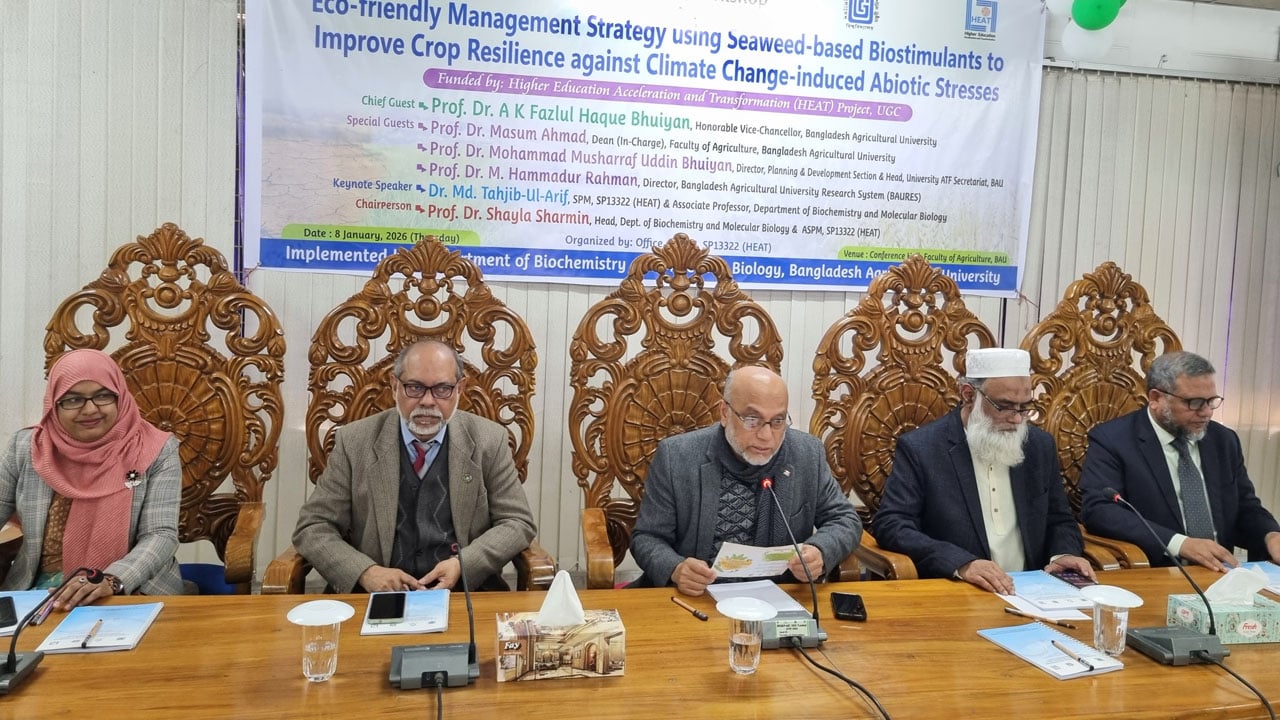
The research was presented at a workshop held at BAU’s Faculty of Agriculture under the project “Higher Education for Agricultural Transformation (HEAT),” jointly organized by the University Grants Commission and the Department of Biochemistry and Molecular Biology. Researchers highlighted that Bangladesh’s coastal areas host abundant seaweed resources, including 47 green, 59 brown, and 94 red species, which contain compounds that promote plant growth and tolerance to salinity and drought.

BAU Vice-Chancellor Professor A.K. Fazlul Haque Bhuiyan emphasized that climate change poses multidimensional challenges to agriculture and that sustainable, eco-friendly technologies like seaweed-based biostimulants could play a vital role in ensuring the sector’s future resilience.

Card image

News Source

Amar Desh 08 Jan 26

দেশে ৩৫ বছরে বেড়েছে ২৬ শতাংশ লবণাক্ত জমি | আমার দেশ

প্রতিনিধি, বাকৃবি প্রকাশ : ০৮ জানুয়ারি ২০২৬, ১৬: ৫৬ প্রতিনিধি, বাকৃবি গত ৩৫ বছরে বাংলাদেশে লবণাক্ত জমির পরিমাণ প্রায় ২৬ শতাংশ বেড়েছে। বর্তমানে দেশের প্রায় ১০ লাখ ৫৬ হাজার হেক্টর জমি লবণাক্ততায় আক্রান্ত। এর মধ্যে উপকূলীয় অঞ্চলের মোট আবাদি জমির প্রায়


The ‘1 Nojor’ media platform is now live in beta, inviting users to explore and provide feedback as we continue to refine the experience.