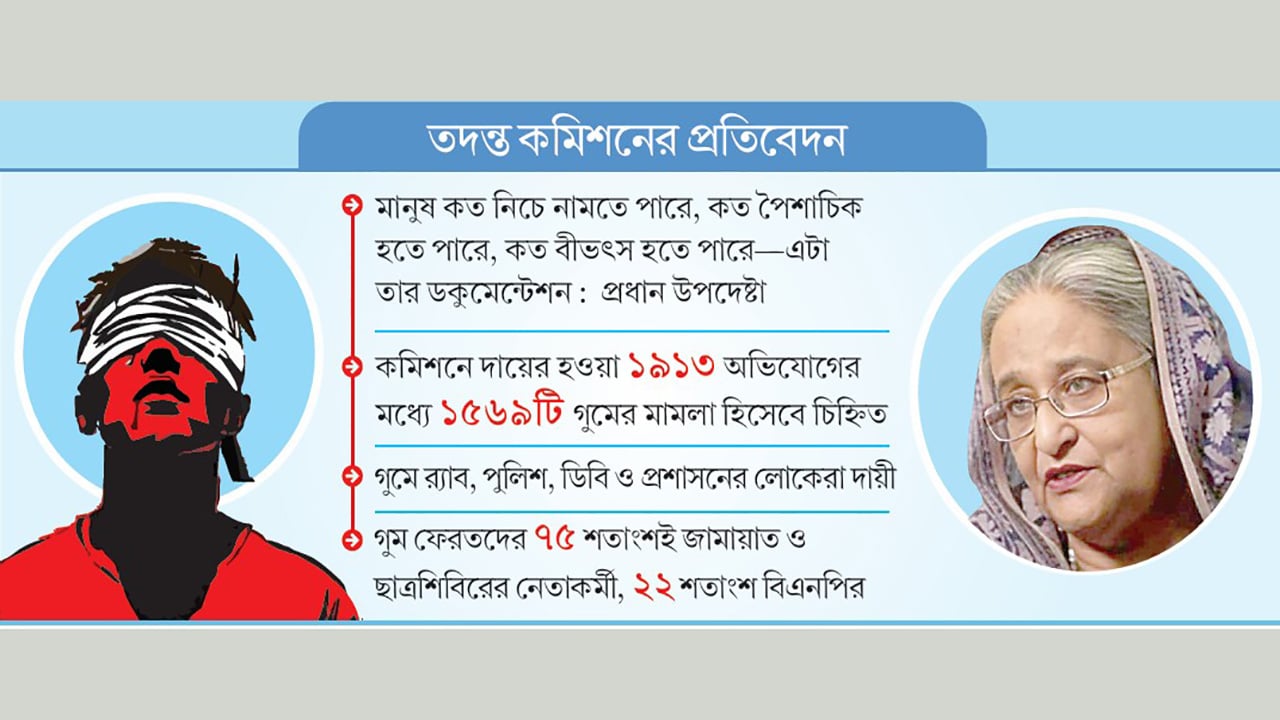
The Commission of Inquiry on Enforced Disappearances in Bangladesh has submitted its final report to Chief Adviser Dr. Muhammad Yunus, revealing that between 2009 and 2024, an estimated 4,000 to 6,000 people were victims of enforced disappearance. Of 1,913 verified complaints, 1,569 were classified as probable cases, with 287 confirmed deaths. The report identifies the practice as systematic, politically motivated, and institutionally coordinated, rather than isolated incidents. It directly implicates former Prime Minister Sheikh Hasina and senior security officials in several high-profile cases.
The commission found that 96.7 percent of victims with known political affiliations were linked to opposition parties, mainly BNP and Jamaat-e-Islami. Law enforcement agencies, including the Rapid Action Battalion, police, and intelligence branches, were named as responsible in most cases. The report documents mass killings and body disposals in rivers such as Baleshwar and Buriganga. Dr. Yunus described the report as a historic documentation of brutality and urged institutional reforms and accountability.
The commission recommended legal and structural reforms to prevent recurrence and ensure justice for victims’ families, emphasizing that enforced disappearances had become a tool of governance during the Awami League era.