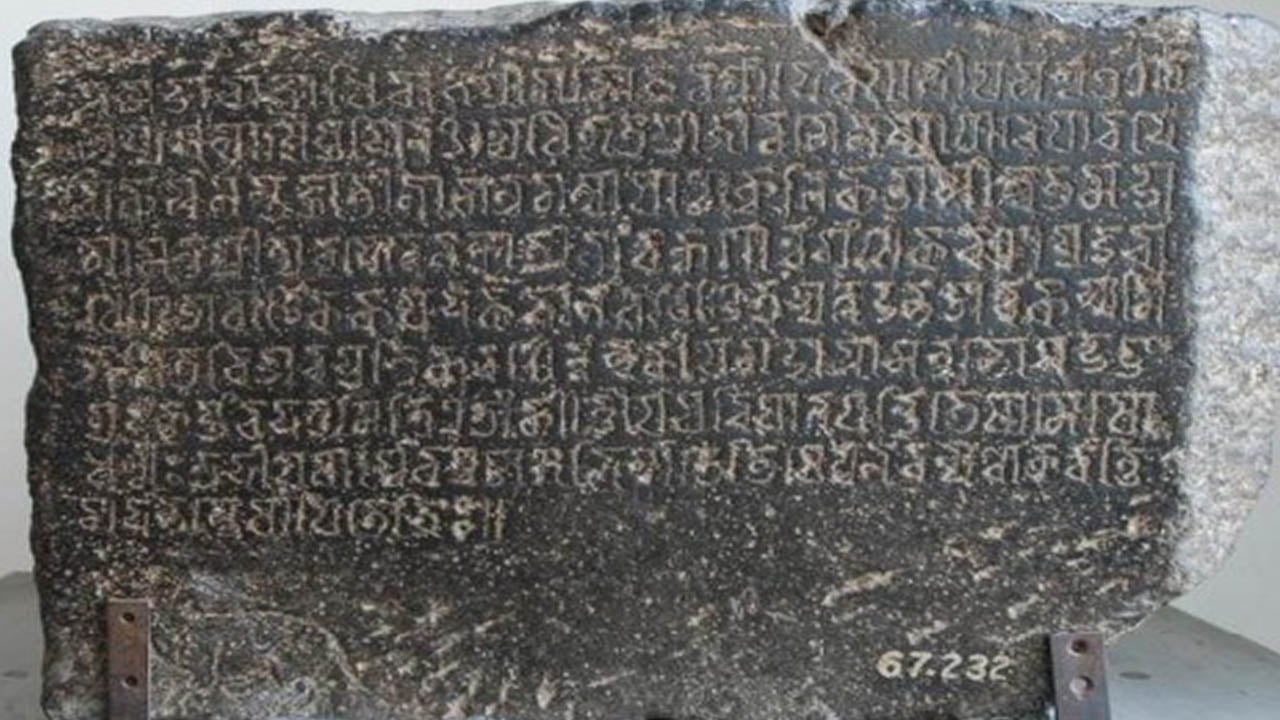
An inscription discovered in 1964 at Sujangarh in Munshiganj, Bangladesh, has been identified as evidence of the oldest Islamic religious establishment in Bikrampur, dating back to the reign of King Bhojavarman of the Barman dynasty (circa 1137–1145 CE). The Sanskrit inscription, containing the term ‘Allabhattarakasvamijanaseetavihara,’ is preserved at the Bangladesh National Museum. Scholars interpret the word ‘Alla’ as a Sanskritized form of ‘Allah,’ suggesting the existence of a mosque-like institution, possibly with an attached madrasa, long before the Turkish conquest of Bengal in 1205 CE.
The inscription records a financial endowment authorized by King Bhojavarman in his seventh regnal year and mediated by a subordinate named Abhudeva, whose name reflects Arabic influence. Later analyses by scholars, including Ryozuke Furui of the University of Tokyo, have highlighted the inscription’s significance as evidence of early Muslim presence in Bengal through trade rather than conquest. It also reflects the cultural pluralism of the Barman rulers, who supported Hindu, Buddhist, and Islamic institutions.
This finding reinforces the historical narrative of religious coexistence and multicultural exchange in twelfth-century Bengal, illustrating how early Bengal society accommodated diverse faiths within its political and cultural framework.