
The ‘1 Nojor’ media platform is now live in beta, inviting users to explore and provide feedback as we continue to refine the experience.
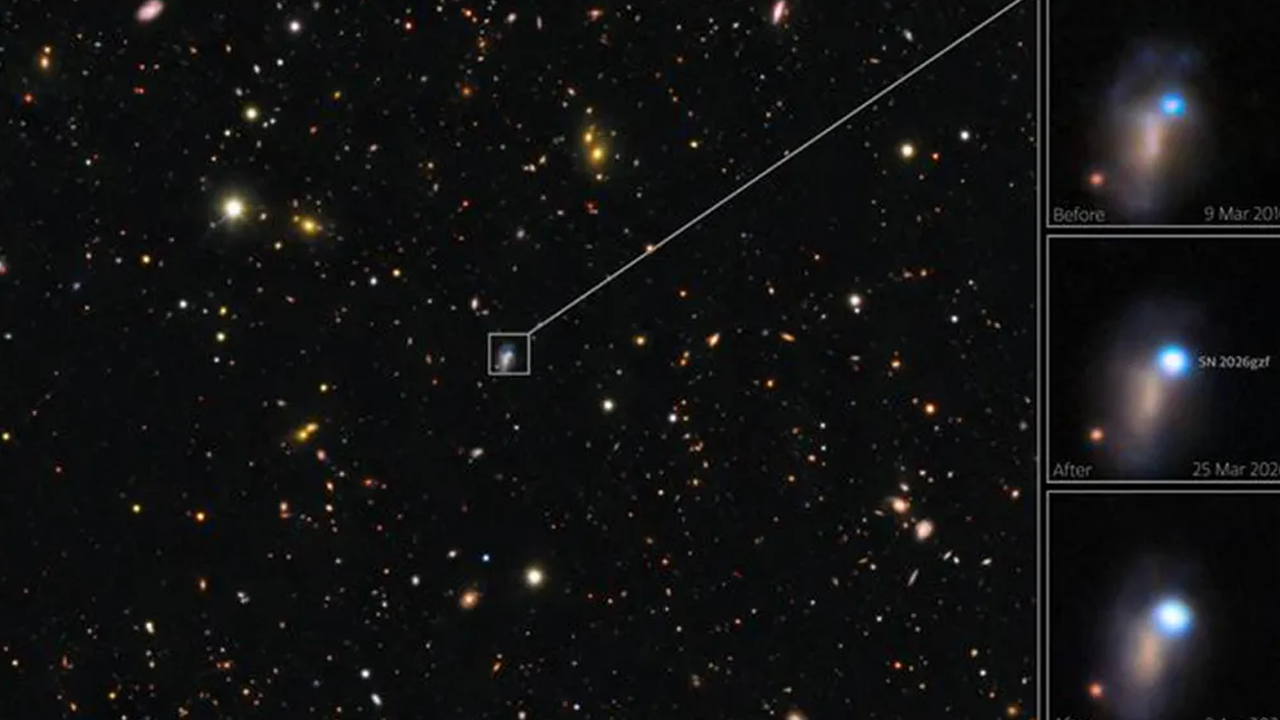
China’s Einstein Probe space telescope detected an unusual X-ray flash in March from a stellar explosion about 500 million light-years from Earth. Within an hour, telescopes around the world turned toward the distant source, which scientists identified as a supernova. The observations captured the brief initial light known as shock breakout, when a shock wave escapes a star’s outer layers. Two papers on the observations were published in The Astrophysical Journal Letters on July 14.
Researchers said this was only the second direct observation of a supernova shock wave in the past 20 years. The event was classified as a Type Ic broad-lined supernova, but its shock breakout was the faintest yet seen for that class. No gamma-ray burst was detected, despite follow-up with sensitive instruments. Co-author Brendan O’Connor said no evidence of such a burst was found, while one possibility is that a jet was trapped by the star’s surface or surrounding material.
The Vera C. Rubin Observatory in Chile, Gemini North and South, and other facilities contributed follow-up observations. The dead star was a Wolf-Rayet star with roughly 20 times the Sun’s mass and had expelled hydrogen and helium before its explosion. Scientists plan to seek more shock-breakout observations to examine whether similar stars undergo comparable final stages.

The ‘1 Nojor’ media platform is now live in beta, inviting users to explore and provide feedback as we continue to refine the experience.