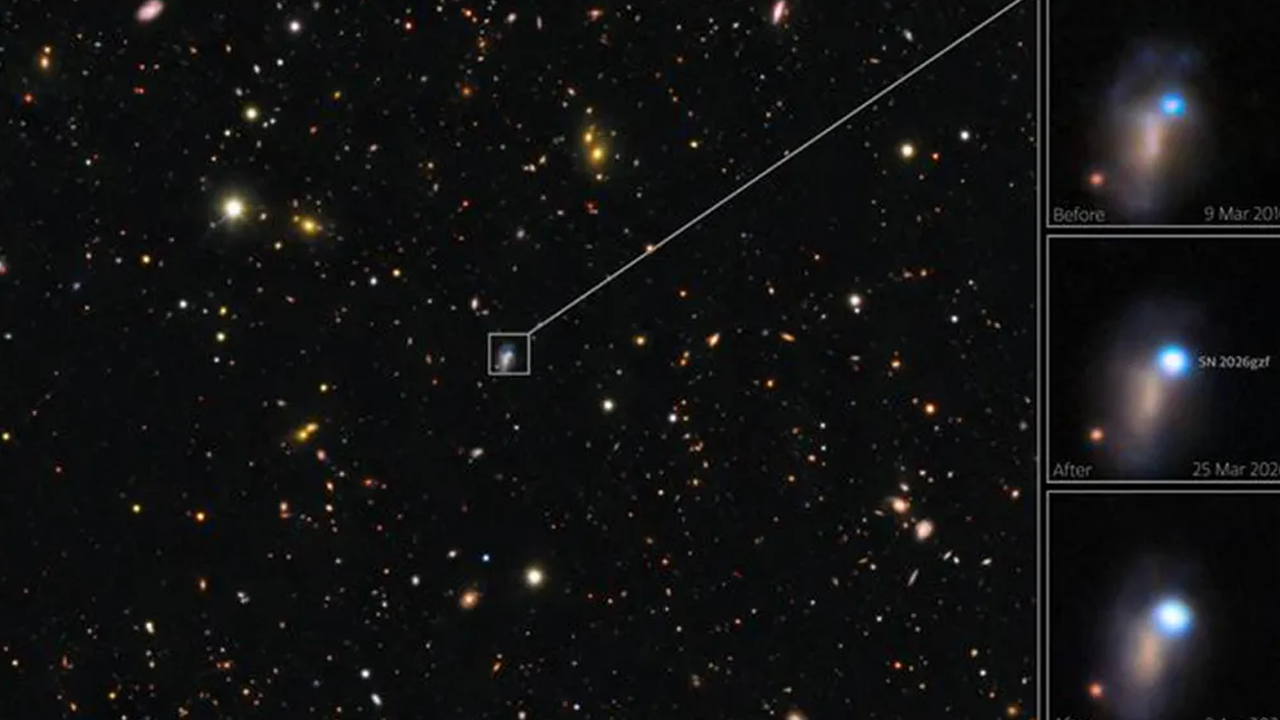
China’s Einstein Probe space telescope detected an unusual X-ray flash in March from a stellar explosion about 500 million light-years from Earth. Within an hour, telescopes around the world turned toward the distant source, which scientists identified as a supernova. The observations captured the brief initial light known as shock breakout, when a shock wave escapes a star’s outer layers. Two papers on the observations were published in The Astrophysical Journal Letters on July 14.
Researchers said this was only the second direct observation of a supernova shock wave in the past 20 years. The event was classified as a Type Ic broad-lined supernova, but its shock breakout was the faintest yet seen for that class. No gamma-ray burst was detected, despite follow-up with sensitive instruments. Co-author Brendan O’Connor said no evidence of such a burst was found, while one possibility is that a jet was trapped by the star’s surface or surrounding material.
The Vera C. Rubin Observatory in Chile, Gemini North and South, and other facilities contributed follow-up observations. The dead star was a Wolf-Rayet star with roughly 20 times the Sun’s mass and had expelled hydrogen and helium before its explosion. Scientists plan to seek more shock-breakout observations to examine whether similar stars undergo comparable final stages.