

The ‘1 Nojor’ media platform is now live in beta, inviting users to explore and provide feedback as we continue to refine the experience.
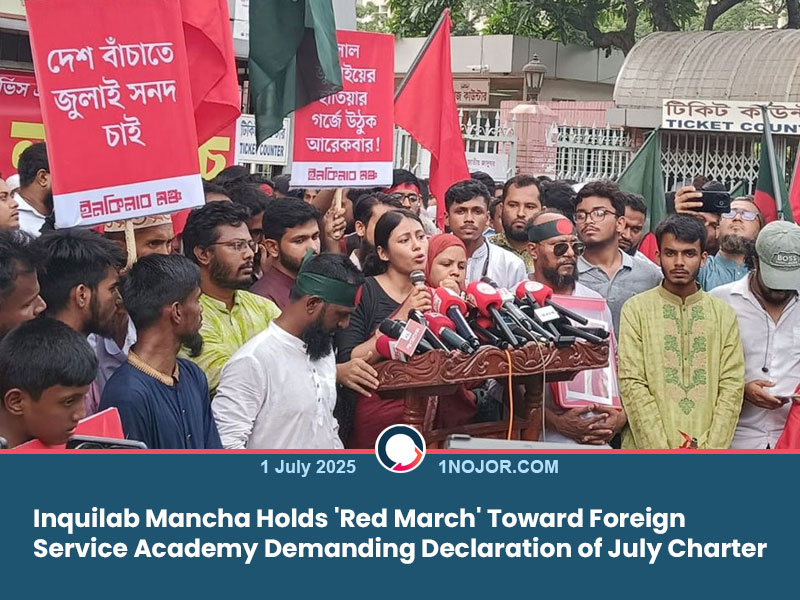
Inquilab Manch organized a ‘Red March’ on Tuesday (July 1), starting from Shahbagh and concluding at the Foreign Service Academy in Dhaka, demanding the announcement of the July Certificate. Speakers at the rally criticized the caretaker government for failing to issue the certificate within the promised 30 working days. They warned that any government formed at the cost of martyrs’ blood must reveal the political pressure it succumbs to. The group called for the July Certificate to be established as the official document of the 180 million people of Bangladesh through a public referendum.
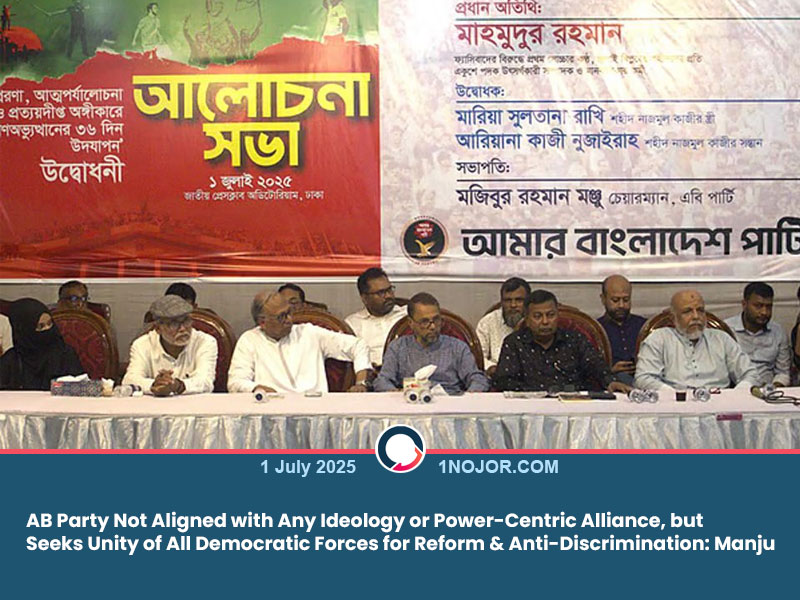
The AB Party has reaffirmed its stance against joining ideological or power-centric political alliances. Instead, it aims to build a coalition of democratic forces focused on anti-discrimination and reform, according to party Chairman Mojibur Rahman Manju. Speaking at the launch of a 36-day July celebration program, Manju emphasized that the unity seen during last year’s uprising should continue, and divisions over reform are now unacceptable. He questioned the growing debate over individual contributions during that movement. At the event, Amar Desh editor Mahmudur Rahman criticized the interim government for not finalizing the July Declaration yet, calling it a significant failure. He also warned political leaders against allowing foreign powers, particularly India, to interfere in the country’s future.
Pakistan has taken over the rotating presidency of the United Nations Security Council for July 2025, marking its eighth term and first since 2013. As a non-permanent member elected with overwhelming support, Pakistan will lead discussions on pressing global security issues, including crises in Gaza and Ukraine. Deputy Prime Minister Ishaq Dar emphasized commitment to UN principles amid growing conflicts. Pakistan will chair key high-level meetings, including an open debate on Palestine, highlighting its important diplomatic role during this tenure.
Inquilab Mancha has announced plans to lay siege to the Secretariat on August 3 if the government fails to declare the "July Charter" by July 31. Spokesperson Sharif Osman Hadi issued the warning during a long march in Dhaka, calling the charter a symbol of anti-fascist struggle. The group presented 13 demands, including justice for victims of past state violence, rehabilitation for injured protestors, and constitutional reform. They also demanded that July 36 be declared National Liberation Day and the charter be made public for feedback.
Retired judge Nizamul Huq Nasim, previously criticized for his role in the 2012 Skype scandal involving alleged government interference in war crimes trials, has been elected to the executive committee of Ain o Salish Kendra (ASK). Nasim had also served as Press Council Chairman under the Awami League, facing backlash for actions against journalists. Human rights groups had strongly condemned his conduct during the tribunal. ASK announced the new committee in a press release following its May 9 general meeting.
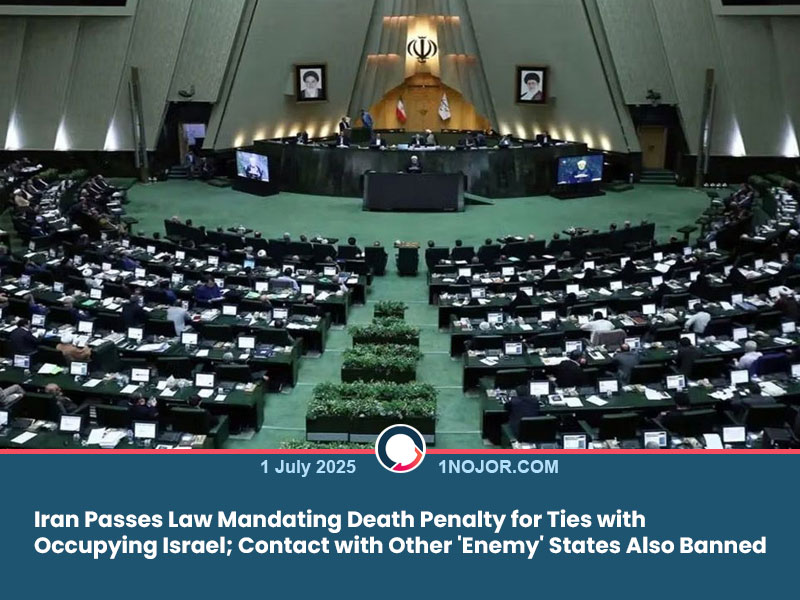
Iran's parliament has passed a stringent new law declaring that any cooperation with the "occupying regime of Israel" or other so-called "enemy states" will be punishable by death. The legislation considers such relations to be acts of "corruption on earth"—a capital offense under Iranian law. The law specifies that espionage, military or technological support on behalf of Israel or the United States will result in the death penalty. Additionally, unauthorized possession, manufacturing, or import of internet equipment—such as Starlink devices—could lead to imprisonment ranging from six months to ten years. Other offenses punishable by death include producing drones for enemy states, engaging in cyberattacks, or attempting sabotage against Iranian infrastructure. Harsh penalties have also been outlined for spreading false information and sharing anti-government content with foreign media.
BNP Chairperson Khaleda Zia has called for preserving national unity at any cost to protect Bangladesh’s democracy and sovereignty. Speaking virtually at a Dhaka event honoring martyrs of the 2024 mass uprising, she condemned the ruling Awami League for 16 years of authoritarian rule. She urged the nation to remember the sacrifices of the victims, compile lists of the disappeared and killed, ensure justice, create employment, and institutionalize democracy. Khaleda appealed to all to realize the vision of building Bangladesh as dreamt by Shaheed Ziaur Rahman.
Chief Election Commissioner (CEC) A M M Nasir Uddin has stated that the Election Commission is fully prepared for the upcoming national elections. He conveyed this during a recent courtesy meeting with Chief Adviser Dr. Muhammad Yunus. According to the CEC, the Chief Adviser is committed to ensuring a free, fair, and credible election and expressed sincere interest in that process. However, Nasir clarified that the exact election date was not discussed during the meeting. Meanwhile, in a separate meeting in London, BNP leader Tarique Rahman urged the Chief Adviser to hold the election in February. In response, Dr. Yunus indicated that elections could indeed be held in February, provided the necessary reforms are implemented.

The Ministry of Liberation War Affairs has officially added 10 more names to the July Mass Uprising martyrs list, bringing the total number of martyrs to 844. The updated list was published in a government gazette on Monday under the July Mass Uprising Martyrs’ Family and July Fighters’ Welfare and Rehabilitation Ordinance, 2025. The newly included martyrs come from various districts including Kurigram, Shariatpur, Dhaka, Chattogram, Noakhali, Jessore, and Bagerhat.
In a powerful Facebook post, political activist Shafiqul Alam has launched a scathing criticism of the ruling Awami League, accusing the party of mocking martyrs, disrespecting protestors, and branding the entire nation as "militants." Alam wrote, "There will never be peace with you until you stand in front of a mirror, see the blood on your hands, and say, 'I'm sorry.' We will continue to resist you—on the land, in the rivers, on the hills, and in the digital world." Reflecting on the past ten months, Alam said the Awami League has demonstrated a colonial mindset and is actively conspiring to regain power through manipulation and oppression. "But this time it won't work," he added. "July has taught us courage and resilience. That strength has become a part of our collective consciousness." He asserted that unless the ruling party apologizes and acknowledges the bloodshed of martyrs, they will never find peace. "The struggle will continue across every domain. Out of respect for those who have laid down their lives, Awami League must one day apologize—otherwise, they will never be at peace," he concluded.

BNP Secretary General Mirza Fakhrul Islam Alamgir emphasized that blaming BNP for opposing reforms undermines national unity. He highlighted that BNP has long advocated for state reforms, announcing 31 demands earlier. Fakhrul stated that the autocratic rule of Sheikh Hasina fleeing opens a chance to build a democratic Bangladesh. Speaking at the July popular uprising anniversary event, he reiterated BNP’s commitment to democracy, unity, independence, and sovereignty, urging the government to implement the proposed “July Charter.”
After 14 years of civil war, Syria is exploring the possibility of normalizing ties with Israel, facilitated by the UAE and supported by U.S. mediation. Talks have reached an advanced stage, focusing on a security agreement similar to the 1974 ceasefire. Key conditions include the removal of Turkish and Iranian-backed forces from Syria and demilitarization of southern regions. Despite deep-rooted hostility, both sides see potential for peace, though challenges remain, particularly over Israel’s control of the Golan Heights.
The responsibility for managing Chattogram Port will be assigned on Wednesday, according to Shipping Adviser M. Sakhawat Hossain. He confirmed that the port's operations will be handed over for a six-month period, but not through a formal tender process. Addressing confusion over a recent gazette declaring port operations as an essential service, the adviser clarified that the existing notification is final and binding. He also acknowledged disruptions at the port caused by protests from the National Board of Revenue (NBR) staff but stated that the impact was not severe. During a high-level meeting, several other key approvals were granted, including those for container handling at Chattogram Port, fertilizer procurement, LNG-related projects, and the reconstruction of 30 schools in Rangpur.
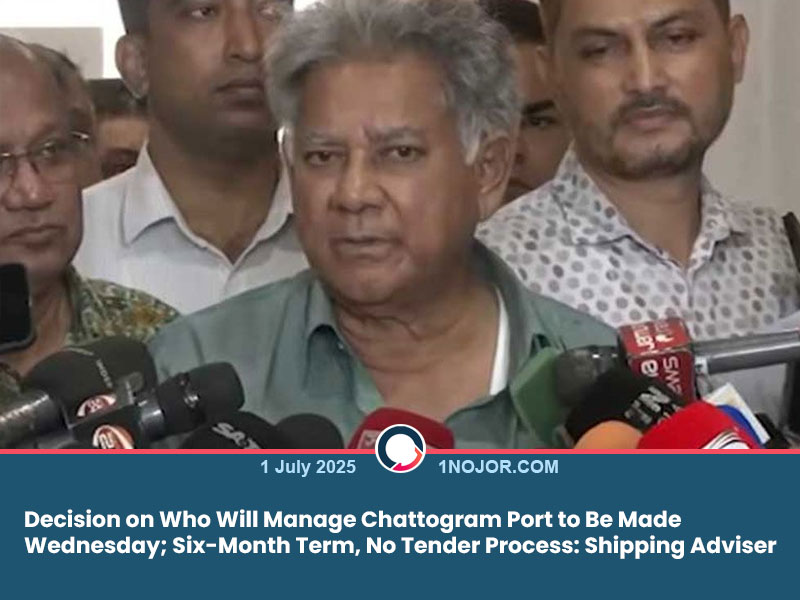
The government has approved a decision for the Chittagong Port Authority (CPA) to operate the New Mooring Container Terminal (NCT) under its own management for six months or until a new operator is appointed. This comes as the contract with Saif Powertec Ltd., the current operator for 17 years, ends on July 6. The decision was taken at a high-level meeting chaired by Dr. Salehuddin Ahmed. No tender will be floated; a direct procurement process will be used.
Ukraine has announced its decision to withdraw from the Ottawa Convention banning anti-personnel landmines, citing national security needs and the ongoing Russian invasion. The move requires parliamentary approval and UN notification. Other Eastern European nations — including Finland, Poland, and the Baltics — are also stepping away from the treaty, citing modern warfare realities. Analysts suggest these countries may begin producing and stockpiling landmines by 2025, further intensifying militarization along NATO’s eastern front.
The ‘1 Nojor’ media platform is now live in beta, inviting users to explore and provide feedback as we continue to refine the experience.