

The ‘1 Nojor’ media platform is now live in beta, inviting users to explore and provide feedback as we continue to refine the experience.
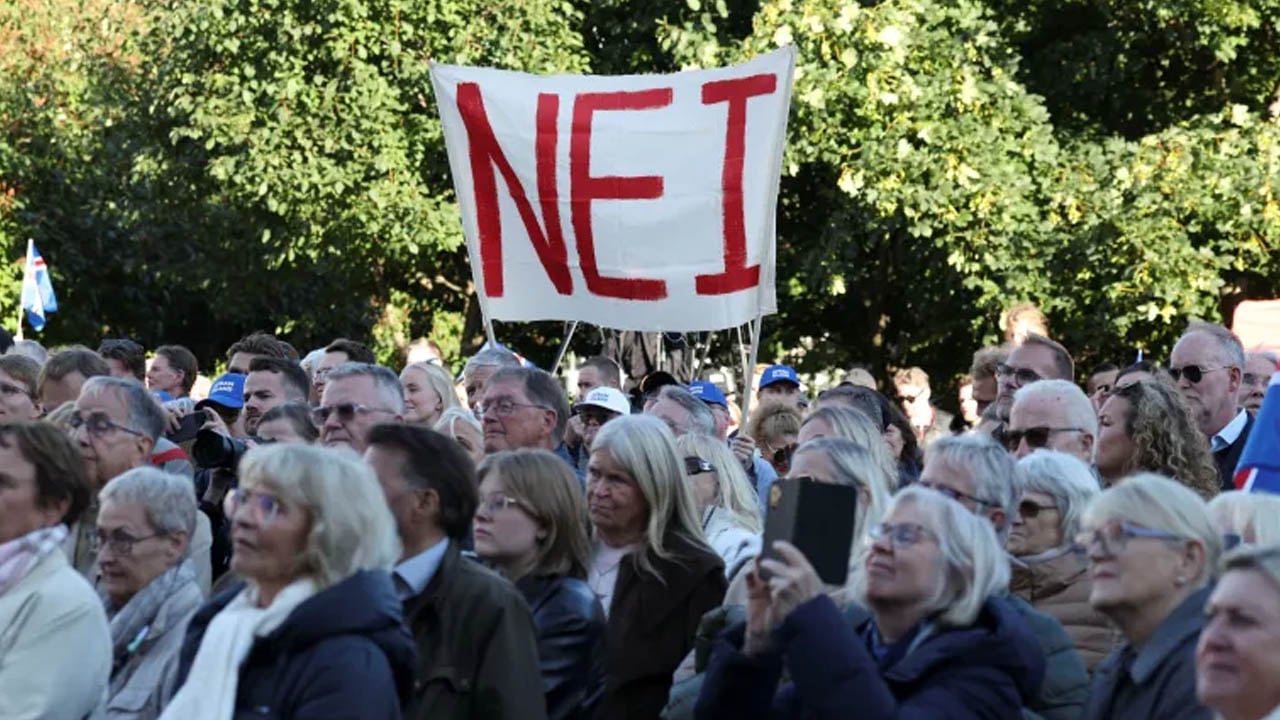
Icelandic voters have rejected a government proposal to begin formal negotiations on joining the European Union, according to the country’s public broadcaster RUV. Results published online on Sunday, with counting nearly complete, showed 52.5 percent voting no and 47.5 percent voting yes. Only a small number of ballots remained to be counted in one of Iceland’s six electoral districts. RUV said the public had rejected the proposal to start membership talks with the EU. The government had presented the initiative as an important “now or never” opportunity. Prime Minister Kristrun Frostadottir told voters in August that a no vote would end all discussion of joining the EU for the time being. Supporters of the yes campaign argued that EU membership could help reduce Iceland’s high interest rates and strengthen security amid international instability linked to the Ukraine war and US President Donald Trump’s comments about bringing Greenland into the United States. Opponents said membership could threaten Iceland’s sovereignty and control over its important fisheries resources. Iceland first applied to join the EU in 2009 during economic pressure from the global financial crisis, but a Eurosceptic government halted talks in 2013.
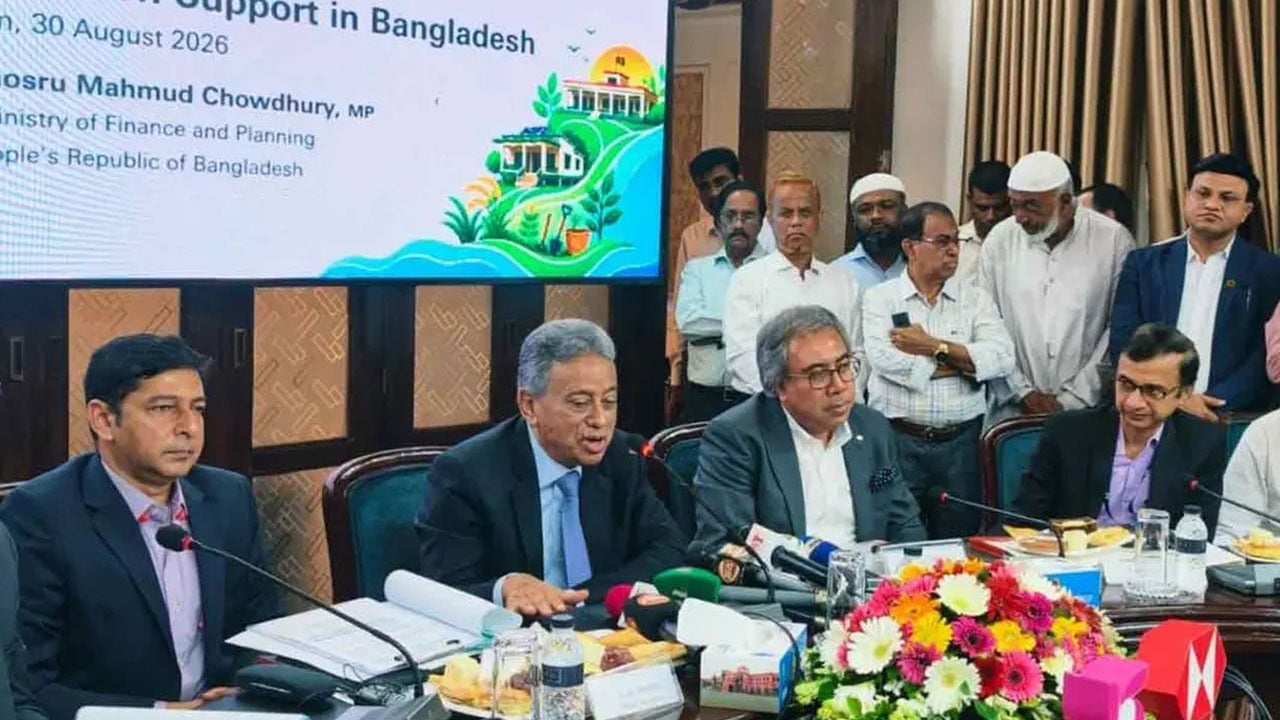
Finance Minister Amir Khasru Mahmud Chowdhury said private-sector firms and NGOs are being included in long-term rehabilitation for people affected by flooding. Speaking on Sunday morning at the launch of a rehabilitation assistance project for flood-hit families at Chattogram Circuit House auditorium, he said allocated aid must reach genuinely affected people with full transparency. The minister said the government provides immediate assistance, while NGOs and private-sector partners are being engaged for longer-term work including educational institution development, support for persons with disabilities and rehabilitation. He said the government alone faces difficulties in distributing all assistance properly, creating scope for corruption and waste. Involving private actors and NGOs can make delivery more efficient and reduce such risks, he added. The BRAC project, financed by HSBC Bank, runs from July 26, 2026 to February 25, 2027 in Banshkhali, Satkania, Chattogram City Corporation’s Ward 38 and Chakaria. It will provide sanitation, housing, livelihood, agriculture, school rehabilitation and awareness support. Heavy rainfall in the first two weeks of July affected about 866,000 people across 10 districts, including Chattogram, Cox’s Bazar, Bandarban, Rangamati and Khagrachhari.
The United States does not currently want to impose secondary sanctions on Chinese buyers over their purchases of Iranian crude oil, but is keeping the measure available as a precautionary option. Former US national security official Mark Pfielfer made the comments in an interview with Al Jazeera. He said the Trump administration and the Treasury Department appear to be keeping the measure ready for use if needed. Pfielfer said broad direct economic action against Beijing would be diplomatically difficult because the US and Chinese economies remain deeply interdependent. According to him, Washington’s current main objective is to create conditions in which China feels comfortable buying fuel oil from alternative sources. He said Chinese refineries are purchasing sanctioned Iranian oil at discounted prices, giving them an economic advantage over global competitors. He also said Beijing has no interest in helping Washington during the international crisis and may be assisting Tehran behind the scenes. Chinese President Xi Jinping is set to visit Washington for a meeting with President Donald Trump on September 24.

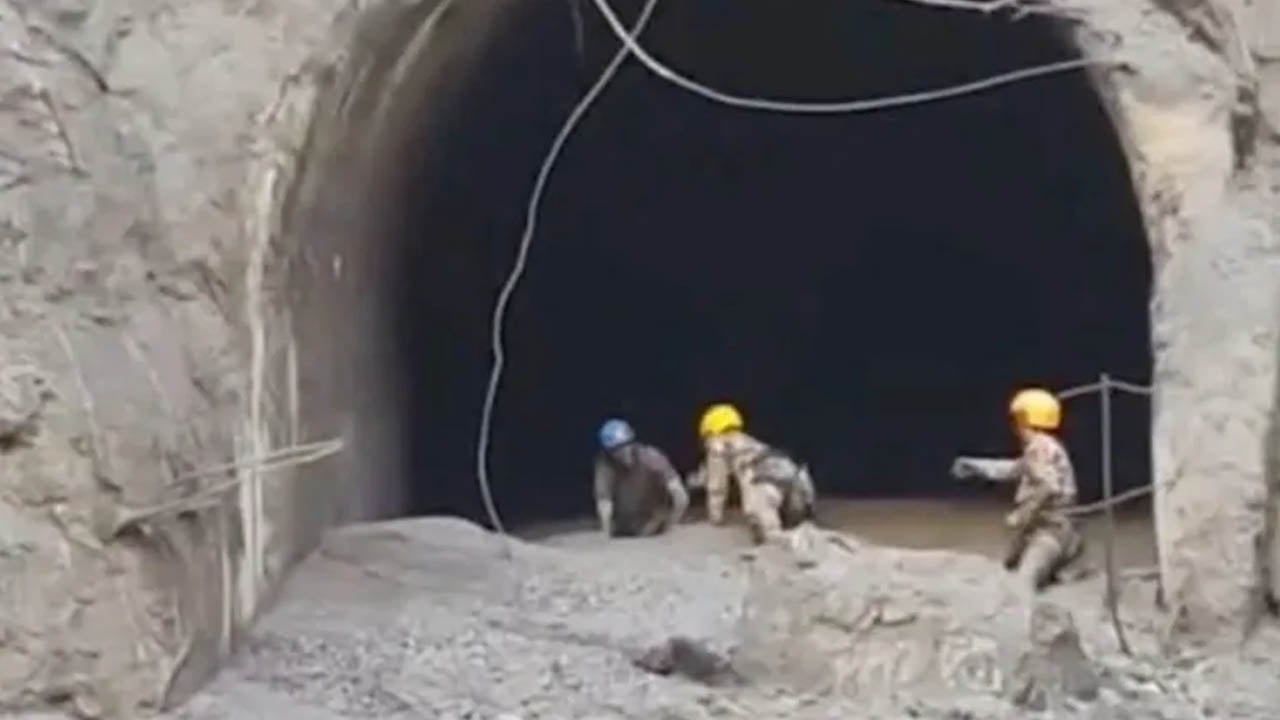
Rescue efforts to reach hydropower workers believed trapped alive in tunnels in Nepal have been disrupted by overnight heavy rain and rising river water. The government said more than 100 workers may remain alive in several tunnels at hydropower projects, while operations have been intensified around the Trishuli-3A and Trishuli-3B project areas. Since mud and debris flows began on Wednesday morning, 933 hydropower workers have been reported missing. At the Trishuli-3A project, an army rescue team reached the upper section of a tunnel buried in mud on Saturday evening using drilling equipment. The team began pumping air into the tunnel and sending in cameras. Nepal Army said on Sunday morning that, after 2 a.m. local time, heavy rainfall raised river levels and flooded the excavated area on the fifth day of the operation. The Prime Minister’s Office said rescuers faced continuous rain and difficult conditions but worked through the night to locate and rescue people who may be inside the tunnels. Specialist tunnel rescue teams from India and China have joined the operation. Eleven hydropower plants and one solar plant, with combined capacity of 431.1 megawatts, have stopped operating.
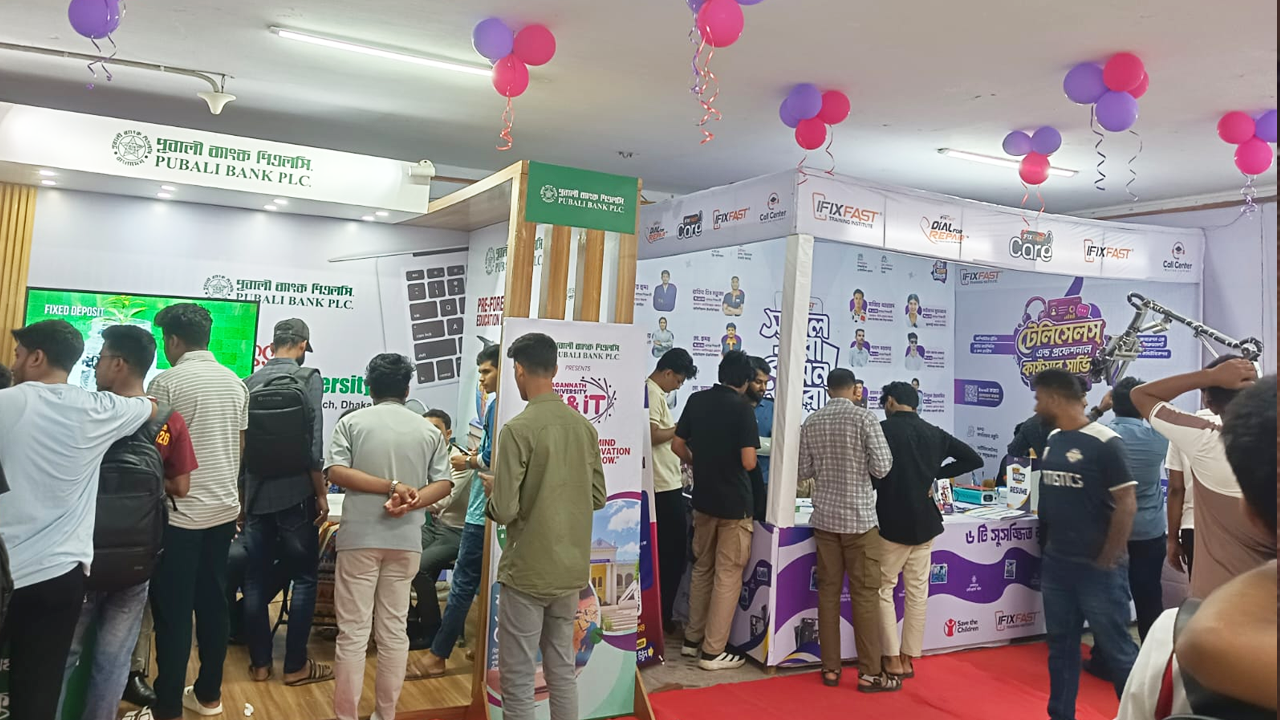
Jagannath University launched the “Pubali Bank PLC Presents Jagannath University AI & IT Fest 2026” on Sunday, August 30, at the Shaheed Sajid Building premises. Organised by the Jagannath University IT Society, the day-long festival brings together students from about 20 universities and 40 technology clubs. Daily Amar Desh is the event’s media partner. The festival includes programmes on artificial intelligence, robotics, innovation, project showcases and olympiads. In the AI Ad-Venture—Prompt to Production Challenge, participants are using AI to turn an idea into a realistic production. The AI & IT Olympiad has junior and senior divisions, while BrainChild Season 2.0 displays apps, websites and AI-based projects developed by young innovators from across the country. TechUncut, Industry Talk and Live Pitch sessions are intended to provide practical industry and career insights through CEOs, industry representatives, technologists, content creators and mentors. A TechCare Zone is also offering software installation, system setup and other technical assistance. Organisers say the event will help students display skills, build networks and connect university innovation initiatives with a national platform.
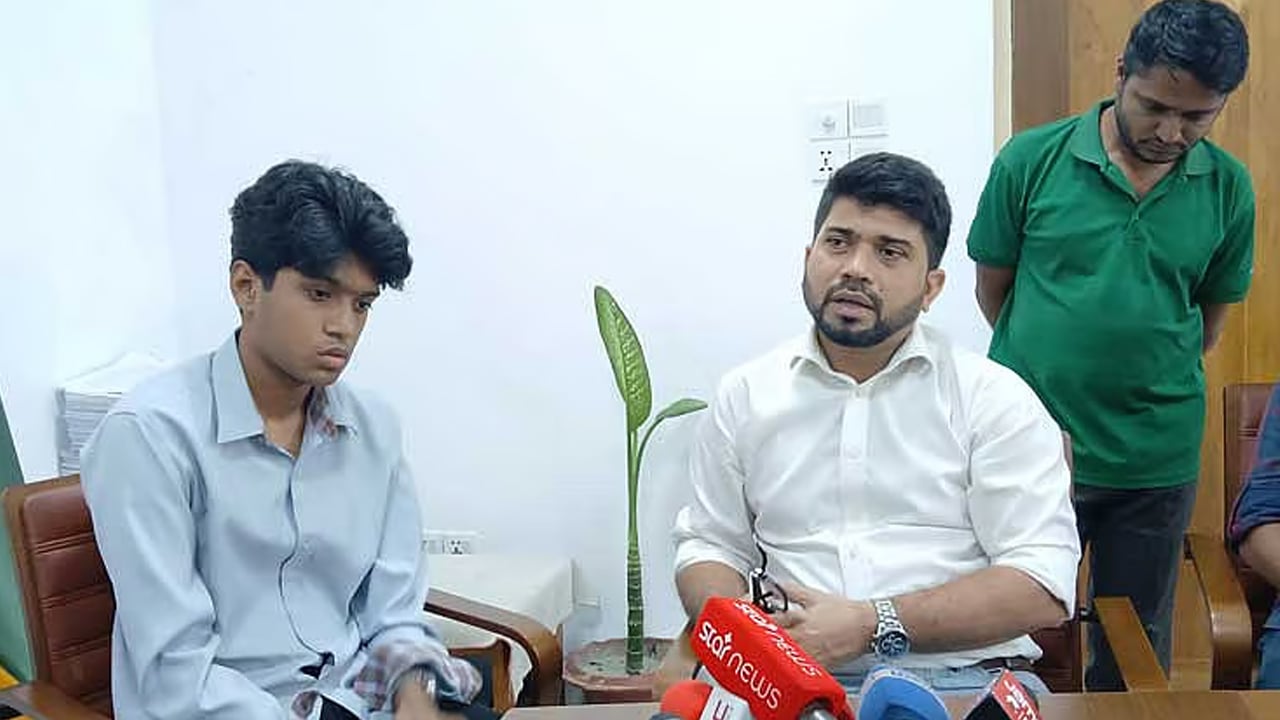
The family of slain journalist couple Sagar Sarowar and Meherun Runi says it will submit a complaint to the International Crimes Tribunal on Monday, seeking progress in the unresolved murder case. Their son, Mahir Sarowar Megh, and Runi’s brother, Nausher Alam Roman, announced the plan after meeting chief prosecutor Aminul Islam at his office on Sunday. The killings occurred at the couple’s rented home in West Rajabazar, Dhaka, on the night of February 11, 2012. Aminul Islam said a lead suggesting the involvement of a cultural figure had emerged while investigators reviewed call detail records during an investigation into another case. He did not disclose the person’s identity. Megh said he wanted proper justice and did not want any innocent person to be implicated. Roman said the family wanted those genuinely involved to be identified. Roman criticised the lack of visible progress by the court-ordered task force and called for the release of people detained by RAB if no evidence of involvement has been found over a long period. He also sought steps to prevent newly named individuals from leaving the country. The chief prosecutor said any formal complaint would be assessed, accepted if within the tribunal’s jurisdiction, or sent to the relevant authority if outside it.
The Middle East could become one of the world’s leading technology hubs by increasing investment in artificial intelligence and financial technology, according to an analysis. The region’s large financial resources, young population, energy advantages, expanding digital infrastructure and location between Europe, Asia and Africa are cited as key strengths. Global AI markets could grow from $407 billion to $990 billion by 2027, while fintech revenue may reach $2 trillion by 2030. A major advantage is the region’s youthful population, with people under 30 accounting for nearly half of residents in many countries. Gulf sovereign wealth funds can support long-term technology and infrastructure projects. Relatively cheap and abundant energy also benefits AI data centres, while 5G networks, cloud technology and data-centre expansion are strengthening digital capacity. Saudi Arabia and the United Arab Emirates have begun major AI and fintech investments. Saudi Arabia’s Vision 2030 seeks a knowledge- and technology-based economy, and the country has declared 2026 the Year of AI. The UAE aims to establish AI leadership by 2031. Experts say other regional states should adopt clear strategies, invest in education and skills, and build on Arabic-language AI and Islamic fintech.

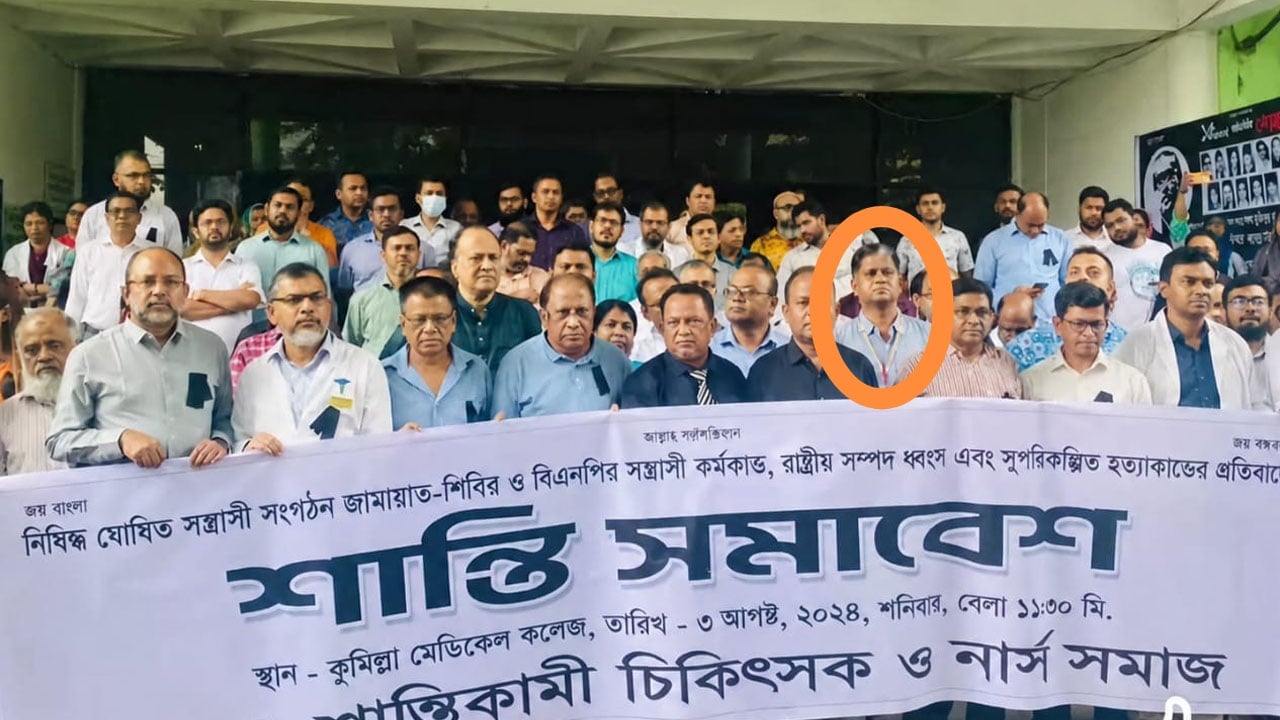
Dr Md Shahjahan, acting director of Cumilla Medical College Hospital, faces allegations of opposing anti-discrimination students during the July-August 2024 uprising and describing BNP rallies as terrorist activities. The report says he actively joined a “peace march” at the hospital on August 3 last year, organised by the group Shantipriyo Chikitsok O Narsra under then director Dr Azizur Rahman Siddiqui. Sources among physicians alleged that the march positioned participants against students while law-enforcement agencies were suppressing the movement. Local allegations also say Shahjahan was close to former Cumilla Sadar lawmaker and local leader Bahar, and used that influence to marginalise BNP-aligned doctors. The report alleges that after the political change, he presented himself as being from a BNP family. The report further claims Shahjahan is lobbying for the permanent director’s post with a recommendation linked to Housing and Public Works Minister Zakaria Taher. Former Cumilla district DAB president Dr M M Hasan said opponents of the 2024 uprising were receiving benefits while sidelining genuine BNP supporters. Shahjahan did not respond to repeated requests for comment, the report said.
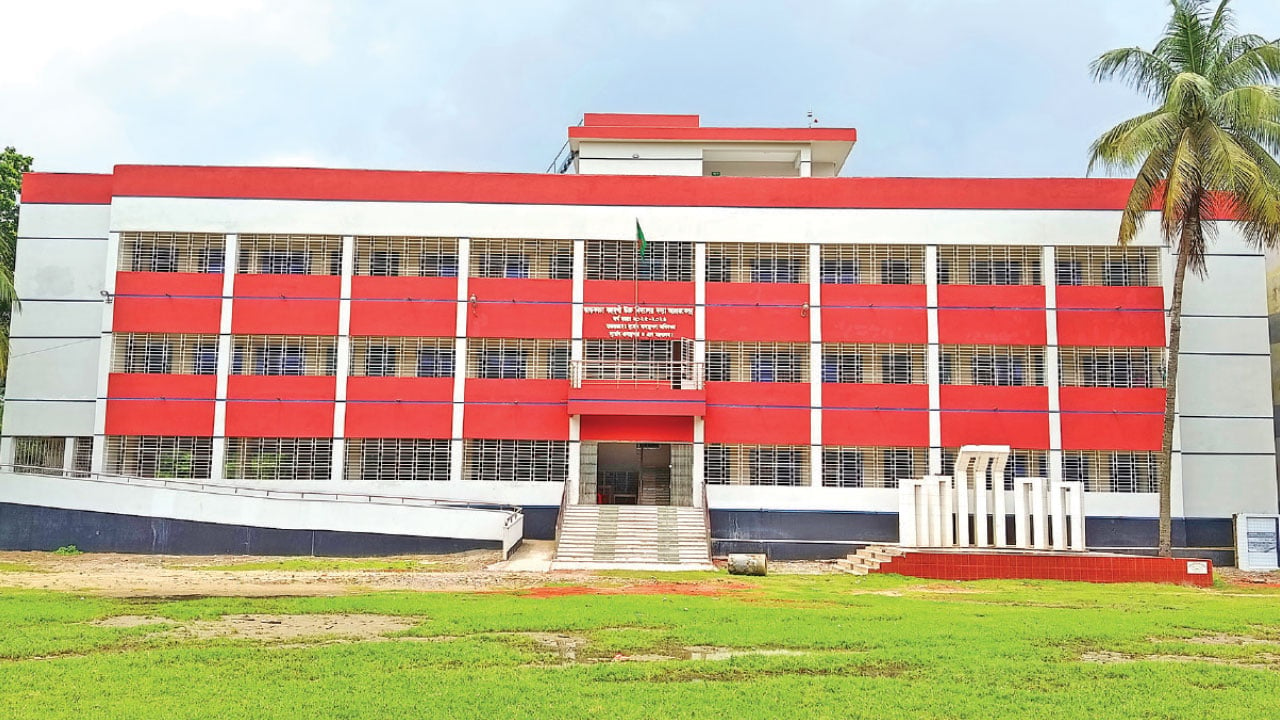
Jharakata Multipurpose High School in Jharakata, Char Pakerdaha Union of Madarganj upazila, Jamalpur, continues its 119-year educational legacy. Founded as a minor school in 1907, the institution was built with support from local residents and now serves about 350 students. It stands on nearly five acres and has become associated with the region’s educational, cultural and social history. A local oral tradition says a wandering woman known as Casho Pagli donated one paisa during discussions on establishing the school and requested that it be built at that location. Residents consider it the school’s first donation. Local sources say several residents later donated land and cash, while Abul Hossain of Mymensingh was the first head teacher. The school first took part in matriculation examinations in 1959. The school has two three-storey academic buildings, one single-storey building, a library and multimedia classrooms, with 13 teachers and six staff members. Forty-seven students sat for the 2026 SSC examination, compared with 50 in 2025. Head teacher Shah Anichur Rahman said the institution is prioritising educational quality and extracurricular activities.
BNP standing committee member and the prime minister’s political adviser Mirza Abbas is scheduled to return to Bangladesh on Wednesday, September 2, after nearly five months of treatment in Singapore and Malaysia. His flight is expected to land at Shahjalal International Airport at 9pm. BNP media cell member Shayrul Kabir Khan confirmed the plan on Sunday. Khan said Abbas has recovered considerably and decided to return home on the advice of a medical board. Abbas lost consciousness suddenly while drinking water during iftar on March 11. As his condition did not improve, he was admitted to Evercare Hospital in the capital later that night. After his physical condition worsened on March 15, Abbas was flown from Dhaka to Singapore by air ambulance. Following treatment there, he was taken to Malaysia for further medical care. Abbas was elected member of parliament from the Dhaka-8 constituency in the 13th national parliamentary election.

Victims of enforced disappearance and the International Committee for the Prevention of Enforced Disappearances questioned the government-approved bill on preventing and remedying disappearances during a march in Dhaka on Sunday, observed as the International Day for the Prevention of Enforced Disappearances. The procession, organised by the committee, headed toward the National Parliament and reached Manik Mia Avenue in front of the parliament at about 4:45pm. The programme continued until 6pm, and participants submitted a memorandum to the Speaker. Many leaders of the Jamaat-e-Islami-led 11-party alliance joined the march. Former military officer and retired Brigadier General Hasinur Rahman raised objections to the proposed law and said he had conveyed the issue to the Speaker. The home minister introduced the Prevention and Remedy of Disappearance Bill, 2026, in parliament on August 27. Debate and criticism had already emerged after the cabinet approved its draft. Critics have particularly objected to keeping responsibility for investigating disappearance-related allegations under law-enforcement agencies rather than assigning it to a separate independent institution.

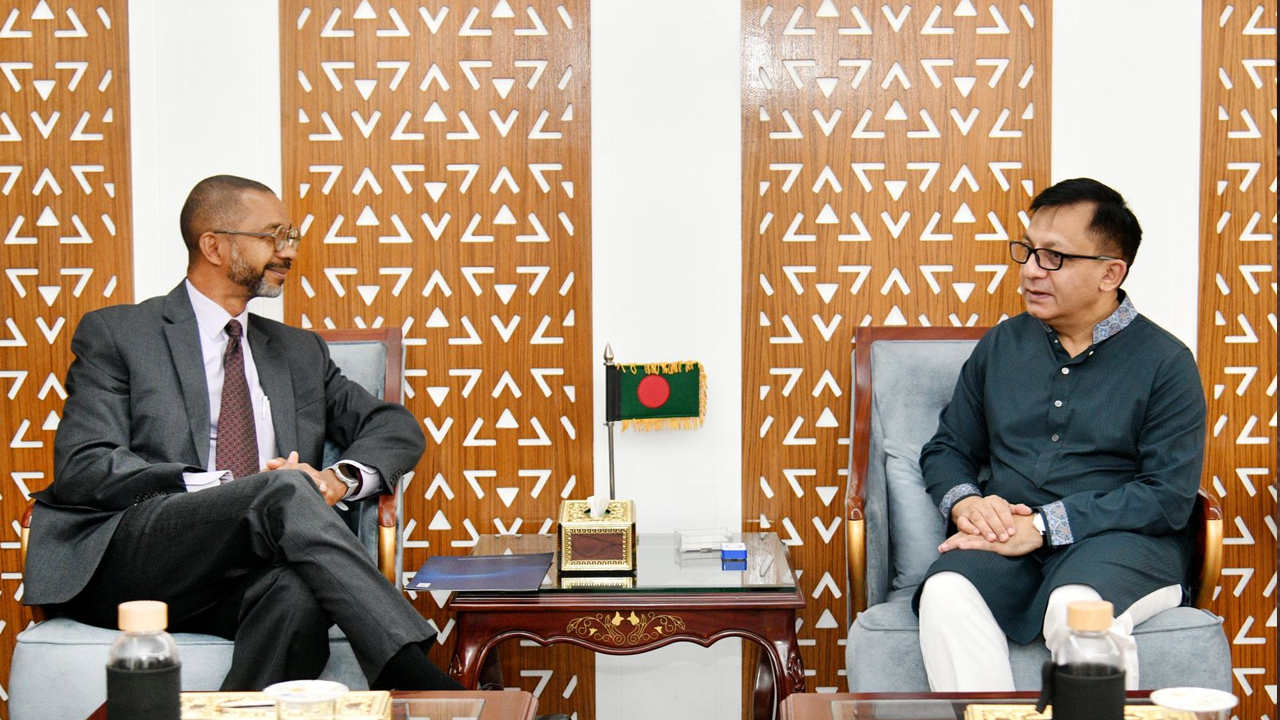
The United Nations Development Programme said it wants to strengthen cooperation with Bangladesh to attract investment, ease business and trade procedures, reduce logistics costs and build the capacity of micro, small and medium enterprises. The issues were discussed on Sunday, 30 August, at a meeting in the Secretariat between Commerce Minister Khandaker Abdul Muktadir and UNDP Bangladesh Resident Representative Stefan Rodriques. UNDP said Bangladesh’s investment potential is increasing and stressed the need to use that opportunity while strengthening local businesses and ensuring environmental and social standards. The minister said the government has taken measures to simplify business licensing and approval processes, reducing some procedures from about three months to within two weeks. He said further steps would be taken to make the processes simpler, faster and more effective. The meeting also addressed reducing high logistics costs and improving efficiency in port and terminal management. UNDP expressed interest in helping link smaller firms to global supply chains, make them export-oriented, reduce unnecessary customs delays, and strengthen Bangladesh’s trade-negotiation capacity through training, tools and international experience sharing. Rodriques said UNDP support would be realigned with government priorities for jobs, growth and economic diversification.
The National Committee for Observance of the International Day of the Victims of Enforced Disappearances submitted a memorandum containing 14 demands to Speaker Hafizuddin Ahmed after a march in Dhaka on Sunday afternoon. The procession began at Banglamotor and moved toward the National Parliament, where participants gathered on Manik Mia Avenue. Leaders and activists of the 11-party alliance actively joined the programme, while opposition members of parliament expressed solidarity. A delegation led by the committee’s joint convener, retired Brigadier General Hasinur Rahman Bir Protik, handed the memorandum to the speaker inside Parliament. Jamaat-e-Islami Secretary General Mia Golam Parwar, senior leaders of the 11-party alliance and opposition MPs were present. Hasinur Rahman said the speaker accepted the memorandum and assured the group that he would make his highest effort to implement the demands. The demands include a strong victim-friendly law, an independent investigation mechanism, accountability for perpetrators and renewed verification of disappearances over the past 15 years. They also call for investigations into secret detention centres, protection and rehabilitation for returned victims, support for families, implementation of a High Court directive in the Miraj Sheikh case, and clear legal procedures for serious or systematic cases.
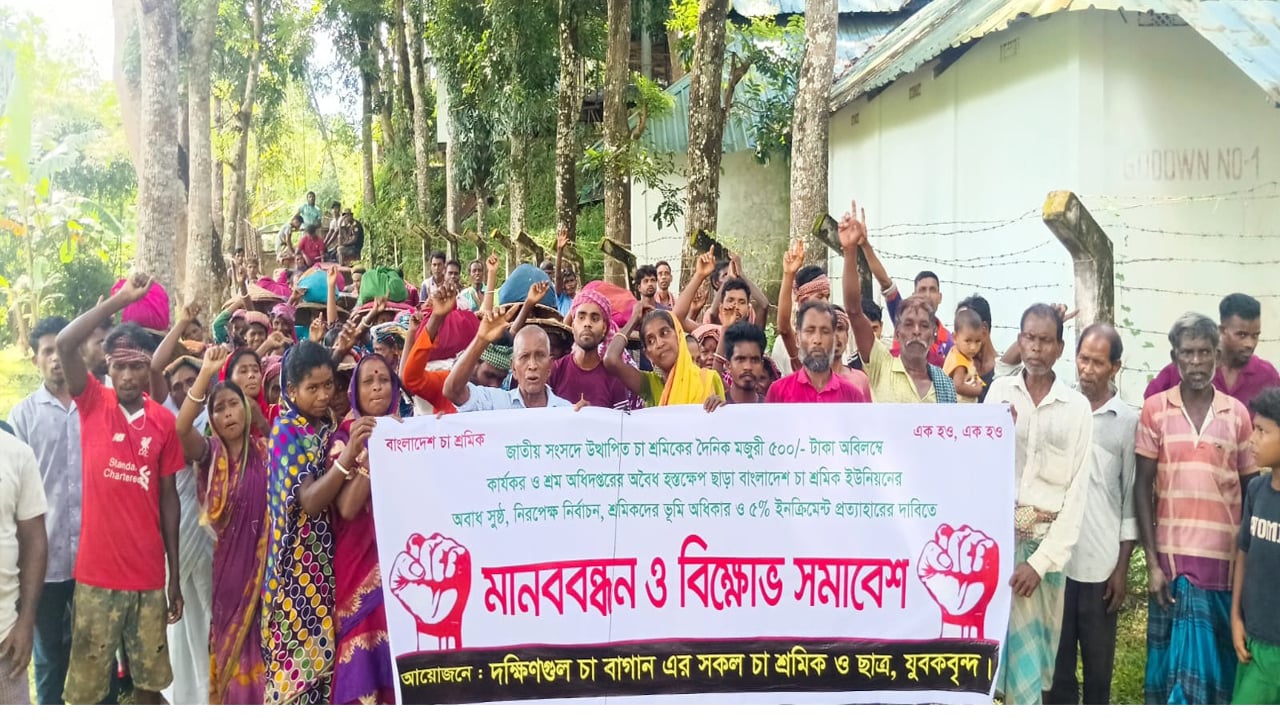
Tea workers in Southgul Tea Garden in Barlekha, Moulvibazar, held a work stoppage, human chain and protest rally on Sunday, demanding implementation of a 500-taka daily wage and four other measures. Workers, students and youths joined the programme under the banner of tea workers, students and youths of the garden. They stopped work from 9am to 10:30am before returning to their duties. The protesters also demanded a free, fair and neutral election of the Bangladesh Tea Workers Union without intervention by the Labour Department, guaranteed land rights for workers, and withdrawal of a 5 percent increment. They brought out a procession from the Bhairabtali Bridge area, marched through roads inside the garden and concluded at the factory gate, where they formed a human chain and held a roadside meeting. Garden Panchayat Committee president Raman Chandra Ghosh chaired the meeting. Other speakers included vice-president Parbati Phulmali, general secretary Nurul Islam, publicity secretary Jugal Phulmali, and workers Suman Ghosh and Nayan Mridha. Workers said the garden has lacked adequate medicine for more than two years and has no doctor, forcing ill workers to pay for treatment themselves. Leaders urged prompt implementation of the demands.
Japan is stepping up efforts to expand trade and reinforce free trade links across global markets amid US tariff policies and growing uncertainty in international commerce. Tokyo is pursuing trade agreements and broader economic cooperation with partners in the Gulf, South America, India and Europe as it seeks to widen its economic diplomacy. The world’s third-largest economy has become more active over the past decade in supporting a rules-based international trading system. Japan is negotiating a free trade agreement with the Gulf Cooperation Council and aims to become the second G7 country, after the United Kingdom, to conclude such a deal. It has also begun trade agreement discussions with Mercosur, the South American bloc of about 280 million people with a combined economy of roughly $3 trillion. Japan imports agricultural products, energy, metals and mineral resources from Mercosur, while seeking future cooperation on rare minerals, lithium and clean energy. Bilateral trade with India reached about $23 billion in fiscal 2024-25, and cumulative Japanese investment there since 2000 exceeded $43 billion. Japan’s economic partnership agreement with the European Union has been in force since 2019.

The ‘1 Nojor’ media platform is now live in beta, inviting users to explore and provide feedback as we continue to refine the experience.