

The ‘1 Nojor’ media platform is now live in beta, inviting users to explore and provide feedback as we continue to refine the experience.
Former U.S. President Donald Trump stated that the United States is willing to ease sanctions on Iran if the country adopts peaceful behavior and coordinates with Washington. In a Fox News interview on June 29, Trump dismissed claims that Iran removed uranium before a U.S. strike, calling it logistically difficult. He also highlighted Iran as the main obstacle to peace in the Middle East and expressed hope that Iran might join the Abraham Accords in the future.
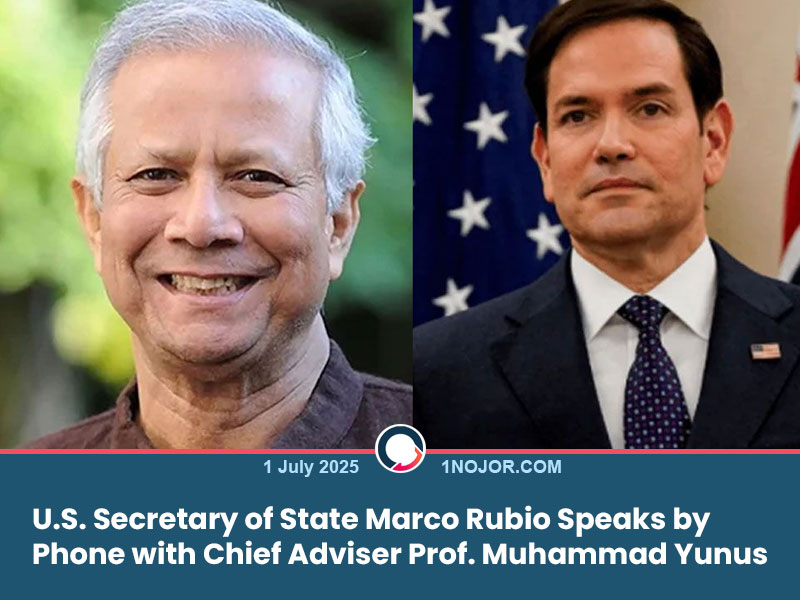
The US State Department has announced that in a recent telephone conversation between US Secretary of State Marco Rubio and Bangladesh’s Chief Adviser Dr. Muhammad Yunus, both sides emphasized further strengthening economic relations and enhancing security and stability in the Indo-Pacific region. During a cordial and constructive 15-minute call, Secretary Rubio and Dr. Yunus reaffirmed their mutual commitment to deepening bilateral economic cooperation and boosting regional peace and stability. The US State Department described the dialogue as a reflection of the excellent bilateral relationship between the two nations.
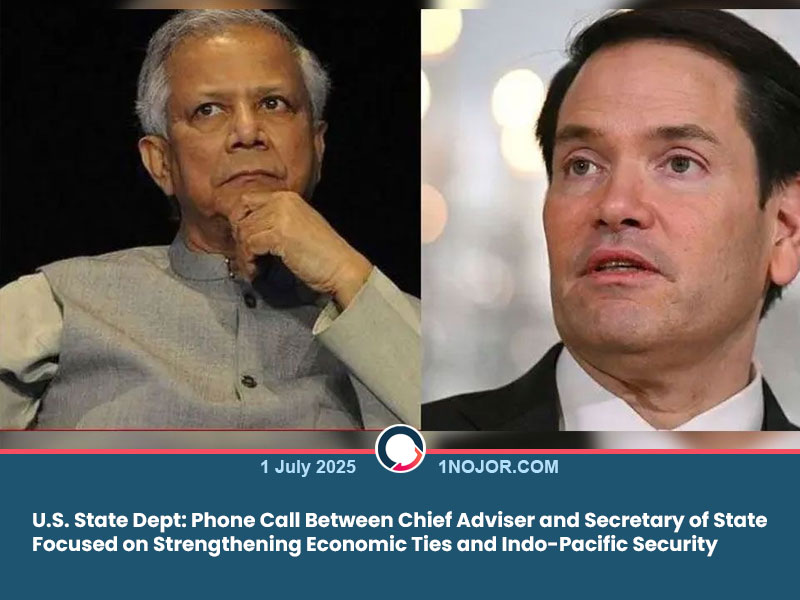
On Monday at 7:30 PM, U.S. Secretary of State Marco Rubio held a telephone conversation with Bangladesh's Chief Adviser, Professor Muhammad Yunus. The discussion, which lasted approximately 15 minutes, focused on strengthening and deepening bilateral relations between the two nations. Press Secretary Shafiqul Alam confirmed the phone call, describing the conversation as sincere, cordial, and constructive. He emphasized that it reflects the strong and friendly ties shared between Bangladesh and the United States.
The Anti-Corruption Commission has launched an investigation into six National Board of Revenue (NBR) officials accused of accumulating illegal wealth and facilitating tax evasion in exchange for bribes. The officials include senior tax and VAT officers who are also active in the NBR Reform Unity Council. ACC clarified that the move is part of a wider anti-corruption effort, not politically motivated. Probes are also ongoing against several other current and former high-ranking NBR officials for similar allegations.
More than 1.2 million stateless Rohingya refugees now live in Bangladesh, comprising over 25% of the global stateless population. Aid for this vulnerable group is rapidly declining, affecting food, education, and healthcare. Repatriation remains uncertain amid Myanmar’s civil war and control of Rakhine by the Arakan Army. International support is shrinking, straining Bangladesh’s resources and fueling local tension. Experts warn of rising crime and drug trafficking as livelihoods vanish. Urgent action is needed for sustainable solutions and increased humanitarian assistance.
A recent BBS survey reveals that 31.67% of Bangladeshi citizens faced bribery and corruption when accessing government services over the past year. The BRTA, law enforcement, passport offices, and land registry offices were identified as the most corruption-prone. The study also highlighted limited freedom of expression, low political participation, and gender-based disparities. Despite some positive feedback on healthcare, education, and safety, nearly 19% reported facing discrimination or harassment. The survey covered 84,807 respondents across all districts following UN guidelines.
Over the past seven years, Bangladesh spent over Tk 2.05 trillion on LNG imports, despite the fuel accounting for just 20–25% of the gas supply. In contrast, only Tk 80 billion was invested in domestic gas exploration over two decades. Experts warn that over-reliance on imports, especially amid Middle East tensions, threatens energy security. They urge increased investment in local exploration. The government now plans to drill 148 wells by 2028 and diversify LNG sources beyond the Middle East.
A recent survey by the Bangladesh Bureau of Statistics reveals that 55.63% of the country’s agricultural land is not being used sustainably, while only 44.37% is managed productively and sustainably. The report highlights issues like soil degradation affecting 72.75% of farmland, limited adoption of proper fertilizer and pesticide practices, and nearly one-third of farmers lacking land security. Despite these challenges, 78.79% of land was profitably used between 2022 and 2024, with most farming families avoiding food shortages last year.
Kishoreganj District Commissioner’s Office has released a recruitment notice for 141 vacancies across 11 different positions. The roles include Draftsman, Office Assistant cum Computer Typist, Nazir cum Cashier, Certificate Assistant, Tracer, Security Guard, Cleaner, and more. Candidates must meet specific educational qualifications and typing speed requirements. Interested permanent residents of Kishoreganj can apply online. The application deadline is July 15, 2025.
Bangladesh Bank formed a five-member committee in January to restructure defaulted loans of 500 million taka or more. Despite receiving 1,253 applications, none have been finalized yet due to complex verification, multiple stakeholders, and regulatory hurdles. The delay has caused an increase in non-performing loans, worsening entrepreneurs’ conditions. Committee members emphasize their commitment but highlight challenges in identifying genuine defaulters and coordinating among numerous banks. The central bank plans to expand the committee to speed up resolutions and support the economy.
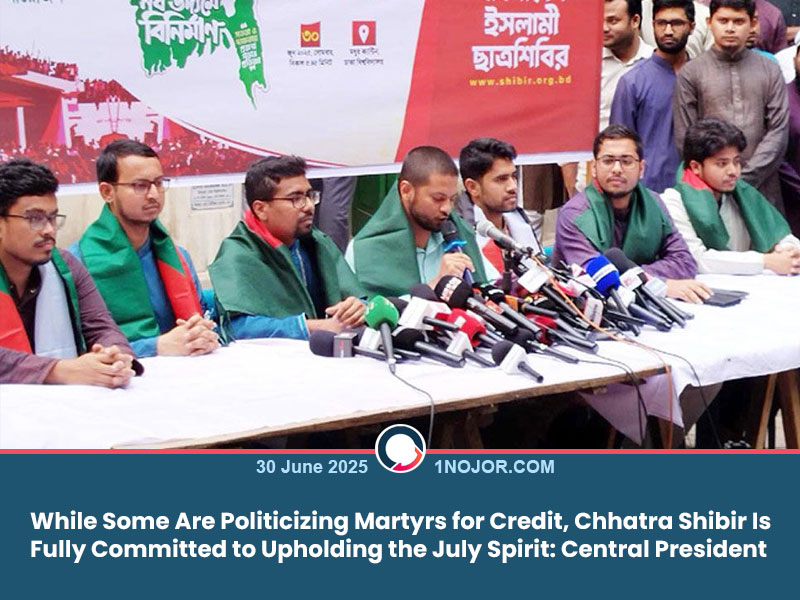
Bangladesh Islami Chhatra Shibir has launched a 36-day campaign titled “July Awakening: Rebuilding with New Energy” to commemorate the first anniversary of the July–August mass uprising. Shibir’s Central President Zahidul Islam said the initiative aims to honor martyrs and preserve the spirit of July through events including symbolic funerals, cemetery visits, photo exhibitions, writing competitions, and demands for justice over past atrocities. He criticized attempts by various factions to politicize the memory of the martyrs and reaffirmed Shibir’s commitment to building national unity and empowering the youth.
Dhaka’s public toilet system reveals major urban planning failures, with insufficient and poorly managed facilities affecting the daily lives of pedestrians, workers, women, and disabled citizens. Experts stress the need for two public toilets per kilometer in this densely populated city. Authorities must integrate toilet provision in all development projects and adopt sustainable management models, including public-private partnerships and technological tools for maintenance and feedback. A coordinated, rights-based approach is essential to make Dhaka a more humane and inclusive city.
Dhaka’s Detailed Area Plan (DAP) highlights the critical need for well-maintained public toilets to improve public health, safety, and social dignity. With rising population pressure, the plan calls for integrating toilets into urban infrastructure, especially in crowded areas like parks and markets. It stresses proper management, environmental sanitation technologies, and facilities for women, children, and disabled citizens. The proposal urges mandatory inclusion of toilets in all development projects, promoting sustainable economic models involving private sectors for upkeep and employment generation.
Bangladesh Economic Zones Authority (BEZA) and the Asian Development Bank (ADB) have signed a landmark agreement to implement the country’s first solar power project under a public-private partnership model. Located in Sonagazi, Feni, the plant will generate 100–200 MW and include a battery storage system. Set on 400 acres of BEZA land, the project aims to reduce carbon emissions and ensure uninterrupted power to industrial zones. ADB will assist with feasibility studies, environmental assessments, and international bidding processes to attract investors.
Bangladesh’s foreign exchange reserves have climbed to $31.31 billion, according to a press release from Bangladesh Bank. However, when calculated under the IMF’s BPM6 methodology, which provides a standardized global framework, the reserve stands lower at $26.33 billion. The discrepancy arises from differing accounting practices, where BPM6 excludes certain unusable funds. The update was shared on Sunday, highlighting the country’s ongoing efforts to maintain a healthy reserve level amid global economic challenges and policy reforms under the IMF’s guidance.
The ‘1 Nojor’ media platform is now live in beta, inviting users to explore and provide feedback as we continue to refine the experience.